
HL‑SFLEX270 270W Ultra-Thin Flexible CIGS Solar Panel
Key Advantages
✅️ Excellent Power Generation Efficiency and Superior Comprehensive Performance
Excellent temperature adaptability (3% higher power in high temperatures than conventional panels) and superior low-light/diffuse light performance (1.5% higher than traditional solutions). No power attenuation in the first 5 years outdoors (unique light bath effect), with overall generation over 4.5% higher than traditional PV systems.
✅️ Ultra-Thin & Lightweight, Suitable for Light-Load Roofs
Ultra-thin (≤2mm) and lightweight (4kg±5% without adhesive backing), about 1/10 the weight of traditional crystalline silicon modules. Perfect for steel structures, metal roofs and light-load buildings, no roof reinforcement needed.
✅️ Simplified Installation, No Roof Damage
Base-free and non-roof-penetrating installation (no roof damage). Adapts to curved/irregular surfaces, saves ~30% on BOS costs, and features faster installation with a more aesthetic finish.
✅️ High Reliability & Low Maintenance
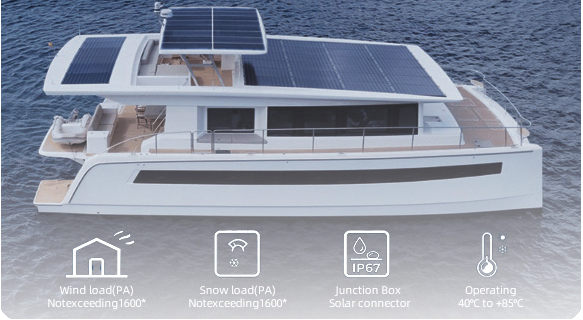
ETFE lamination (same as Water Cube) with nano self-cleaning, hail-resistant, and suitable for harsh environments (dusty, humid, salt-spread, hazy). Built-in bypass diodes (no hot-spot effect), Safety Class II, Fire Rating B1, operating temp -40℃ to +85℃, low maintenance required.
✅️ Professional Warranty
1-year warranty for materials & workmanship; 90% power output at 10 years, 80% at 25 years.
Product Parameter
-METER-ELECTRICAL PERFORMANCE AT STC
| Nominal Power | 260W\270W\280W\290W |
| Nominal Efficiency | 14.4\15\15.5\16.1% |
| Power Output Tolerance | +5/0W |
| Maximum Power Voltage | 67.2\69\70.8\72.6V |
| Maximum Power Current | 3.89\3.93\3.96\4.00A |
| Open Circuit Voltage | 85.6\87.1\88.7\90.2V |
| Short Circuit Current | 4.66\4.62\4.59\4.55A |
| Maximum Series Fuse Rating | 10A |
| Maximum System Voltage | 1000V |
-PHYSICAL&MECHANICAL SPECIFICATIONS
| Length | 5905mm(+5/-2) |
| Width | 348mm(+2/-2) |
| Thickness, Maximum at J–Box*,Module | 17mm |
| Weight | 3.4Kg (Module without adhesive)
4.9Kg (Module with adhesive) |
| Weight/Area | 1.6kg/m2(Module without adhesive)
2.4kg/m2(Module with adhesive) |
| Cable Connections | MC4 Compatible |
| Cell Type | Copper Indium Gallium Diselenide(CIGS) |
| Warranty | 5 year workmanship;5/10/25 year power output |
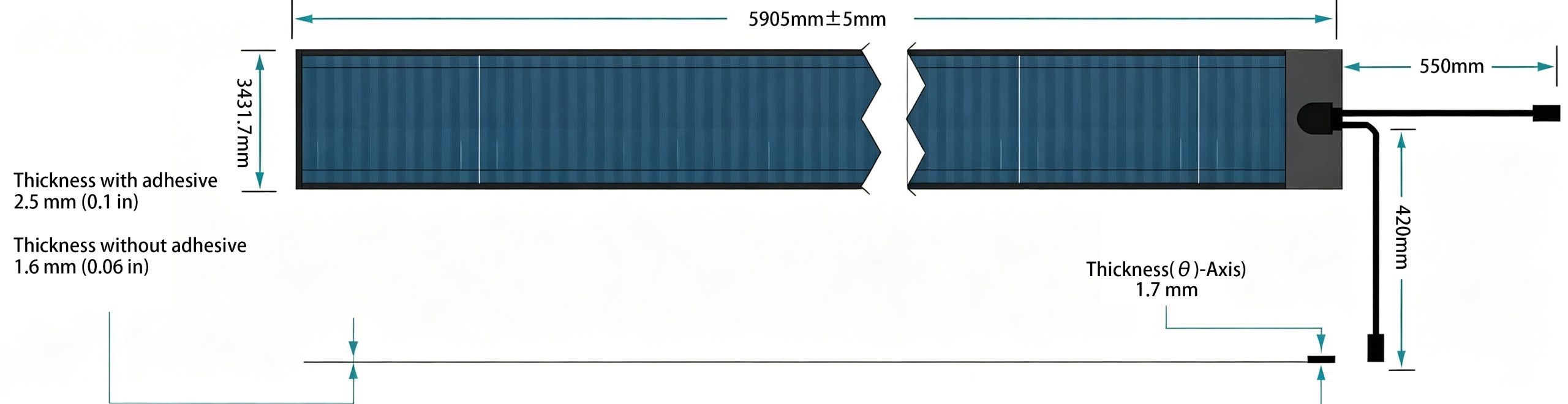
Product dimensions diagram
Applications
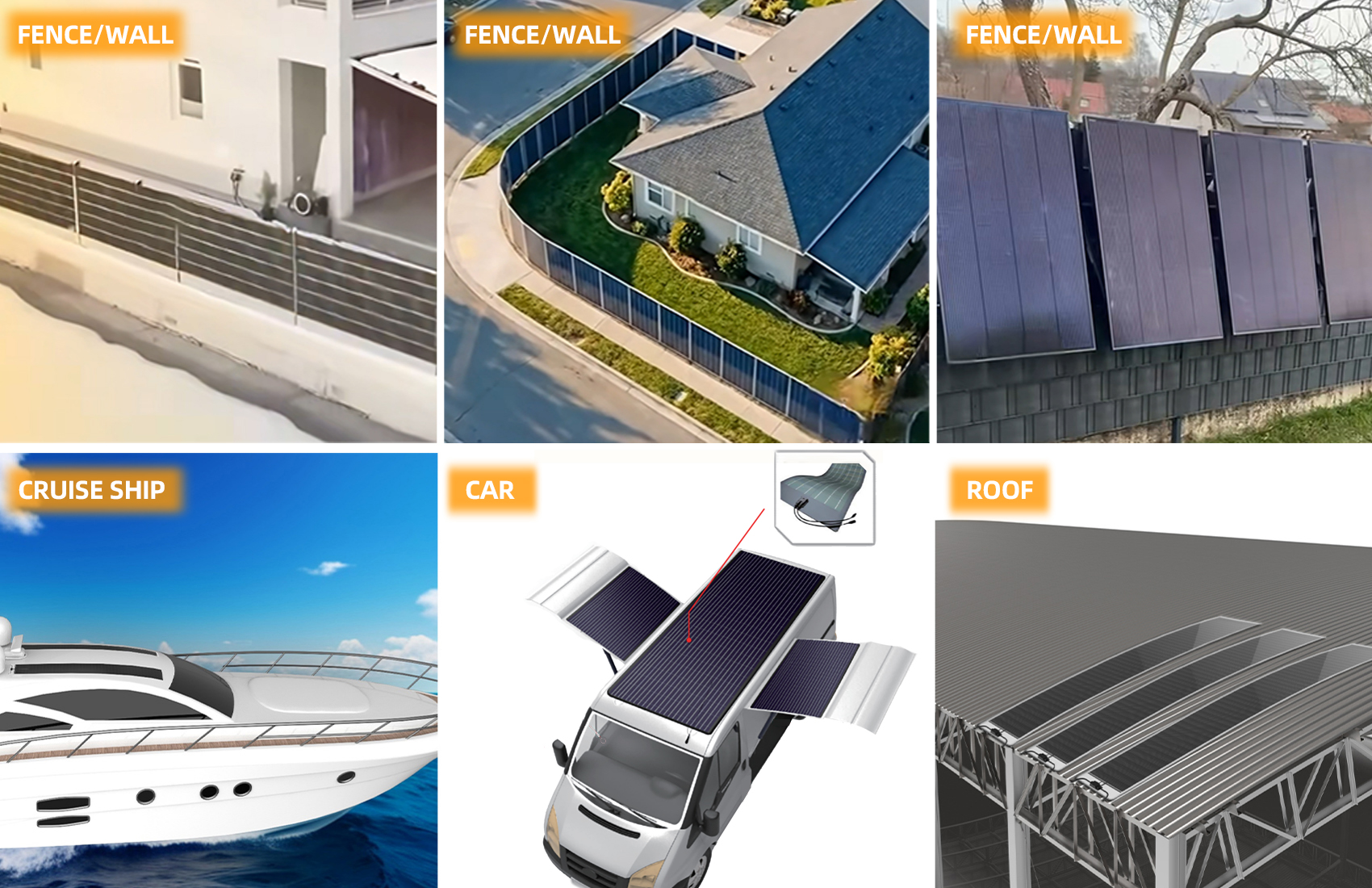
Buildings: Steel roofs, metal roofs, factories, warehouses
Transport: RVs, yachts, trucks, marine vessels
Integration: Fences, facades, off‑grid power, outdoor equipment
Environments: Humid, salt‑spray, dusty, coastal, high‑latitude areas
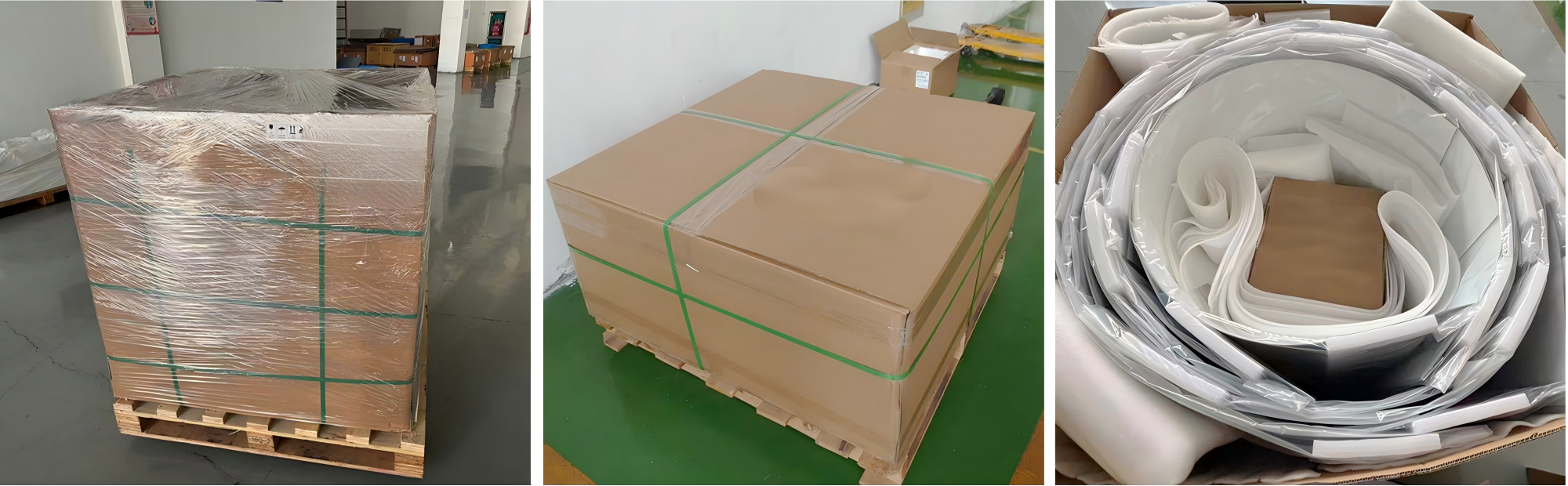
Product Packaging
FAQ
Q1: What is the bending radius of flexible solar panels? Will bending affect power generation efficiency or service life?
A: Flexible solar panels support safe flexible installation with a recommended bending radius ≥500mm, which can be adapted to curved roofs, corrugated metal roofs, curved RVs, ships and various irregular surfaces. The flexible solar cells (such as CIGS, thin-film modules, etc.) and ETFE lamination adopted have excellent flex resistance. Within the standard bending range, it will not cause power loss, module cracking or shortened service life, and can meet the needs of BIPV (Building-Integrated Photovoltaics) and mobile installation scenarios.
Q2: Do I need brackets, concrete bases or roof drilling to install flexible solar panels? Will it damage the roof waterproofing?
A: No brackets, no concrete bases, and no roof penetration are required. It can be installed by butyl adhesive bonding or pressure strip fixing. This installation method can fully protect the roof structure and waterproof performance, does not add additional wind load, and can save about 30% of system cost (BOS) and labor cost. It is suitable for various scenarios such as metal roofs, factory roofs, RVs and ships.
Q3: How is the low-light performance of flexible solar panels on cloudy days, dawn/dusk or in high-latitude areas? What advantages do they have over traditional crystalline silicon panels?
A: Most flexible solar panels adopt thin-film technology (such as CIGS), which have excellent low-light and diffuse light utilization capabilities. At an irradiance of 600W/㎡, the relative power generation efficiency can reach 101.5%, and they can generate electricity stably in cloudy, low-light and high-temperature environments. Its temperature coefficient is only -0.36%/℃, and the power generation in high-temperature environments is 3% higher than that of traditional crystalline silicon panels. The total power generation is more than 4.5% higher than that of traditional photovoltaic systems, making it particularly suitable for use in high-latitude, rainy, high-temperature and high-humidity areas.
Q4: Flexible solar panels are only 2mm thick and lightweight, are they strong enough? Do they have hail resistance, salt spray resistance and dust resistance?
A: Flexible solar panels adopt high-strength ETFE lamination (the same material used in the Water Cube), which has the characteristics of UV resistance, anti-aging and hail impact resistance, and can adapt to complex environments such as coastal salt spray, high humidity, and heavy dust and haze. The product has passed the IEC 61215 mechanical load test and can withstand snow and wind loads of 1600Pa. Although it is light and thin, it has extremely strong durability and can meet the needs of long-term outdoor use.
Q5: What is the “no hot-spot effect”? How do flexible solar panels achieve it? What is its important significance for system safety?
A: The hot-spot effect refers to a phenomenon where local areas overheat when photovoltaic modules are shaded or malfunction, which may lead to module burnout or even fire. Flexible solar panels have bypass diodes built into every 2 cells and are equipped with junction box protection, which can automatically bypass shaded or faulty cells, completely eliminate the hot-spot effect, effectively improve the safety and stability of the system, extend the service life, and meet the Class II safety level and B1 fire rating standard.
Q6: What is the operating temperature range of flexible solar panels? Can they work in extremely cold or hot environments?
A: The official standard operating temperature range of flexible solar panels is -40℃ to +85℃, which can work stably in extreme environments such as extremely cold (such as Northeast China, plateau areas), tropical and high-temperature areas. It will not be brittle in low-temperature environments and will not have power attenuation in high-temperature environments, adapting to various outdoor deployment scenarios around the world.
Q7: What is the ETFE nano self-cleaning function? Do flexible solar panels need frequent cleaning and maintenance?
A: The surface of flexible solar panels usually adopts an ETFE nano self-cleaning coating, which has dust-proof, anti-fouling and hydrophobic properties. Rainwater can naturally wash away surface pollutants, without frequent manual cleaning and maintenance. It can not only reduce maintenance costs, but also continuously maintain high light transmittance and power generation efficiency, making it very suitable for use in urban and industrial dusty environments.
Why Choose HELIST Flexible CIGS Solar Panel
-Advanced Thin-Film Technology, Stable Performance & High Energy Yield
Adopting advanced thin-film technology, flexible solar panels deliver superior performance compared to traditional silicon panels in harsh environments such as low light, high temperature, and high-latitude regions. Their excellent light absorption capacity ensures higher overall energy generation, effectively improving long-term return on investment (ROI) for users.
-Ultra-Thin & Lightweight, Versatile for All Light-Load Roofs
With an ultra-thin design (only 2mm thick) and lightweight feature (around 4kg), flexible solar panels require no structural reinforcement or roof modification during installation. They are perfectly suitable for various scenarios including old factory buildings, metal roofs, curved surfaces, and other structures that cannot bear heavy loads.
-Tool-Less & Easy Installation, Reduce 30% Installation Cost
Featuring a tool-less installation design, flexible solar panels eliminate the need for bases, drilling, and racking. The simple and efficient installation process allows single-person deployment, significantly reducing labor costs and balance of system (BOS) expenses.
-All-Weather Durability, Long Service Life
Designed with strong durability, flexible solar panels are resistant to hail, salt spray, humidity, and dust. Equipped with ETFE self-cleaning coating, they can effectively prevent dust accumulation and avoid hot spot issues, ensuring a long and stable service life.
-Reliable Quality Assurance & Long-Term Warranty
Produced by professional manufacturers with strict quality control standards, flexible solar panels come with a comprehensive warranty service — typically 1-year material warranty and 25-year power output warranty (ensuring 90% power retention in 10 years and 80% in 25 years), providing users with long-term peace of mind.
-Global Certifications & Multi-Scene Application
Compliant with international certifications such as IEC, UL1703, and RoHS, flexible solar panels have a B1 fire rating and Safety Class II. They are widely applicable to industrial, commercial, and residential scenarios, as well as marine and vehicle-mounted applications, meeting diverse energy needs.
Perhaps you still want to know
HL‑SFLEX110 110W Ultra‑Thin Flexible CIGS Solar Panel
https://www.pv-magazine.com/tag/cigs-solar-cells/